

Lessons learned from London’s refurbishments while occupiers stay in situ.
There are key principles to making a success of complex refurbishments.
Delivering major refurbishment projects while buildings remain fully occupied is becoming an increasingly common requirement across the
London office market.
Rising construction costs, limited new supply and tightening ESG regulation mean both landlords and occupiers are prioritising in-situ
upgrades over relocation. Recent projects delivered by Oxygen Asset Management, including One Basinghall Avenue, Ryder Court and the
forthcoming works at 30 Gresham Street, provide clear lessons on how these complex schemes can be successfully managed.
Rather than focusing on individual project milestones, Oxygen’s experience highlights a repeatable set of principles that underpin
effective delivery in live environments. These lessons are shaping how the business approaches future occupied refurbishments across its
portfolio.
Lesson 1: Business continuity must drive the programme
The overriding priority on any occupied refurbishment is maintaining uninterrupted business operations. At One Basinghall Avenue, Standard Chartered’s City headquarters remained fully operational throughout extensive works including full MEP replacement and sustainability upgrades. This required programmes to be structured around occupier needs rather than construction convenience, with
detailed phasing, temporary arrangements and careful sequencing around live services.
Experience shows that early agreement of non-negotiables such as access routes, working hours, security requirements and critical
operational periods is essential. Where continuity is treated as a core design and programme constraint from the outset, disruption can be
minimised even on highly complex schemes.
Lesson 2: Phasing and logistics are as important as design
Occupied refurbishments succeed or fail on logistics. Projects such as Ryder Court demonstrated the importance of developing granular
phasing strategies where no swing space is available. Lift refurbishments, services upgrades and amenity works were carefully sequenced to protect tenant welfare and maintain safe, functional buildings throughout.
This experience reinforces that design solutions must be tested against real-world buildability in live conditions. Construction
methodology, access planning and contractor coordination need the same level of scrutiny as architectural or technical design.
Lesson 3: Continuous tenant engagement reduces risk
Transparent and consistent communication with occupiers is fundamental. Across all projects, Oxygen has found that regular reporting, clear programmes and proactive discussion of upcoming activities significantly reduce operational risk and build trust.
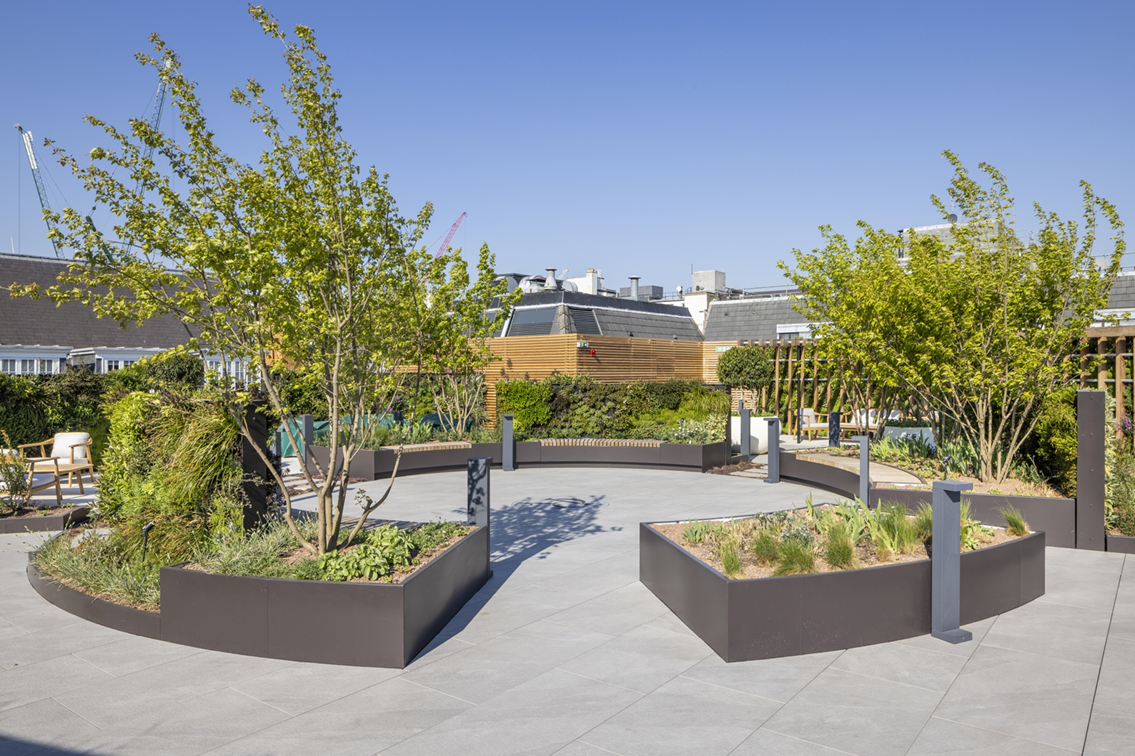
Ryder Court. (Colins Contruction)
At One Basinghall Avenue and Ryder Court, close day-to-day engagement enabled issues to be addressed early, expectations to be managed realistically and programme adjustments to be agreed collaboratively. This approach avoids escalation and supports smoother delivery in environments where tolerance for disruption is low.
Lesson 4: Integration of asset and development management adds value
A key differentiator in Oxygen’s delivery model is the integration of asset management and development management functions. Acting in
both roles allows leasing strategy, ESG objectives and investment planning to be aligned directly with construction delivery.
At One Basinghall Avenue and Ryder Court, this integrated approach enabled lease regears to progress in parallel with refurbishment
works, ensuring that commercial outcomes were secured alongside physical improvements. The same model is now being applied at 30
Gresham Street, where multiple tenants with differing requirements must be balanced within a single delivery strategy.
Lesson 5: Sustainability outcomes are achievable without decanting
“A common concern is that ambitious sustainability targets require vacant possession. Oxygen’s recent projects demonstrate that this is not necessarily the case.”
— Fraser Draycott, Head of Construction, Oxygen
A common concern is that ambitious sustainability targets require vacant possession. Oxygen’s recent projects demonstrate that this is
not necessarily the case. One Basinghall Avenue is targeting EPC A and NABERS 4.5 stars, while Ryder Court achieved BREEAM Outstanding and EPC B, all delivered while tenants remained in occupation.
The lesson is that sustainability performance must be embedded early, with clear targets informing design, procurement and phasing
decisions. Retrofitting in occupation requires discipline and coordination, but strong ESG outcomes remain achievable.
Lesson 6: Adaptability is essential in live environments
Occupied buildings inevitably present unforeseen constraints, whether technical, operational or occupier-led. Successful delivery
depends on the ability to respond quickly and pragmatically. Across Oxygen’s projects, programme flexibility and empowered decision-making have been critical in managing change without compromising safety, quality or business continuity.
These lessons are now informing Oxygen’s approach to upcoming schemes, including the major repositioning of 30 Gresham Street, where three long-term tenants will remain in occupation during extensive upgrades to mechanical, electrical and plumbing systems, amenities and sustainability performance.
By applying a lessons-learned framework focused on continuity, communication, integration and adaptability, Oxygen AM has established a robust and repeatable model for delivering refurbishment projects in live environments. In a market where relocation is increasingly impractical, the ability to upgrade buildings without disruption is becoming a defining capability, one that Oxygen continues to refine and apply across its portfolio.
Fraser Draycott, Director, Head of Construction, Oxygen, Development Manager